Lyft’s Insurance Gap Inside Brooklyn
Lyft’s own driver insurance page states plainly that the company does not procure coverage for rides involving TLC-licensed drivers operating within New York City. That includes every Lyft pickup in Brooklyn. Instead, the driver or the base company affiliated with that driver must carry a separate commercial policy that satisfies TLC rules, set at a minimum of $100,000 per person and $300,000 per accident.
 In contrast, a Lyft ride that begins in Westchester or out on Long Island operates under a different framework entirely, with Lyft’s own contingent and primary liability coverage stepping in during different phases of the trip, sometimes reaching $1 million. A Brooklyn passenger gets none of that corporate backstop.
The practical result is that a catastrophic injury, the kind that generates hundreds of thousands of dollars in surgery and rehabilitation costs, can run straight past the available insurance before anyone even discusses what your pain and suffering is worth.
Most riders learn about this gap for the first time from us, not from Lyft. The company’s policy language sits in a driver-facing help article that passengers never see before they request a ride, and nothing in the app interface discloses it.
That asymmetry matters in a Brooklyn case because it shapes the entire negotiation. An insurance adjuster representing the driver’s TLC policy knows the limit is fixed at $100,000 per person, and that number becomes the ceiling unless we can identify another responsible party or another applicable policy.
So Who Pays When the TLC Policy Isn’t Enough?
The driver’s commercial insurer is the first stop, and it is rarely the last one. We look at the base company the driver is affiliated with, since some TLC bases carry coverage above the regulatory floor to attract drivers. We also examine whether the crash involved a second vehicle, because that driver’s separate liability policy may offer an entirely independent source of recovery.
Lyft itself can sometimes be named directly, not through its driver insurance program but through ordinary negligence theories: negligent screening of a driver with a known history of violations, or a defect in how the app routed the driver into a dangerous maneuver.
These claims are harder to win than a straightforward insurance claim, and Lyft’s lawyers will argue independent contractor status at every turn, but they are not impossible, and we evaluate them in every case where the TLC policy alone will not make our client whole.
We also pull the driver’s TLC licensing history early, since prior violations, suspensions, or complaints can support a negligent retention theory against the base company that is affiliated with that driver.
A base that kept dispatching rides to a driver with a documented pattern of unsafe conduct carries its own exposure separate from the driver’s personal liability, and that exposure sometimes opens a path to recovery that the driver’s policy alone could never reach.
Finding every available policy is what we do first. Call us at 718-946-2273 to start your free case review today.
What If a Different Driver Hit the Lyft You Were Riding In?
A large share of the Lyft accident calls our Brooklyn office receives involve a driver who had nothing to do with Lyft at all. A box truck blows a stop sign on Fourth Avenue. A driver merging onto the Gowanus Expressway clips the Lyft’s rear panel while doing sixty.
 In these cases, the at-fault driver’s personal or commercial auto policy becomes the primary target, and the no-fault PIP coverage tied to the Lyft vehicle still pays your initial medical bills no matter who caused the wreck.
If that other driver carries minimal insurance, or none at all, the picture gets harder. TLC vehicles are not required to carry supplementary uninsured/underinsured motorist coverage the way personal vehicles elsewhere in the state are, under VTL Section 1693.
Your own auto policy, if you carry SUM coverage on it, becomes the most realistic path to full compensation in that scenario, which is one more reason we ask about your own insurance during the very first call.
Crash Patterns We See Across Brooklyn’s Lyft Trips
Prospect Park West generates a steady stream of conflicts between Lyft drivers cutting across the protected bike lane and cyclists who have the right of way. Bay Ridge Parkway and the service roads feeding the Gowanus Expressway see frequent rear-end collisions during evening rush, when traffic compresses without warning near the on-ramps.
Bushwick and East Williamsburg, with their narrow industrial streets and heavy truck traffic, produce a disproportionate number of side-impact crashes at unmarked intersections.
Night rides out of Brooklyn’s nightlife corridors, particularly around Williamsburg and DUMBO, carry their own risk profile. Drivers working late shifts after a full day on the app show measurable fatigue, and our review of crash reports in these areas routinely turns up drivers who had been logged into the app for ten or more consecutive hours before the collision.
Weather adds another layer specific to the borough’s older housing stock and uneven street grading. Heavy rain pools quickly along stretches of Eastern Parkway and parts of Sunset Park, where drainage has not kept pace with development, and a driver moving at normal speed through standing water loses traction faster than most passengers realize.
We pull weather data and 311 drainage complaint records for the relevant block whenever a crash report mentions wet conditions, since that history can support a claim that the road itself contributed to what happened.
Deadlines That Control Your Brooklyn Lyft Claim
 New York’s no-fault rules require you to submit your claim for medical and lost-wage benefits within 30 days of the crash, regardless of how the case eventually resolves in court. Miss it, and the insurer has grounds to deny coverage even if your underlying injury claim remains strong.
CPLR 214(5) then gives you three years from the date of the accident to file a personal injury lawsuit, a deadline the Kings County Supreme Court enforces without exception for late filings.
Recovering for pain and suffering, rather than just your medical bills, also requires meeting the serious injury threshold set out in New York Insurance Law Section 5102(d).
The statute lists nine qualifying categories, including bone fractures, permanent loss of use of a body organ, and an injury that prevents you from handling your normal daily routine for 90 of the 180 days following the crash. A soft tissue strain that resolves in a few weeks generally will not clear that bar, no matter how painful it felt at the time.
The 30-day no-fault window closes fast. Call Finz & Finz, P.C. at 718-946-2273 before a deadline costs you benefits.
Protecting Your Claim From the First Hour
Photograph the inside and outside of the vehicle before you leave the scene, including the Lyft driver’s dashboard mount and any visible damage. Save the trip receipt and the in-app chat with your driver, since Lyft can deactivate that data from your account view faster than most riders expect.
If police respond, get the report number before you leave, since requesting it later means navigating a separate records request with the NYPD.
Decline any recorded statement an insurance representative asks for in the days after the crash, whether they identify themselves as Lyft’s carrier, the driver’s personal insurer, or your own. These calls happen while you are still in pain, often on medication, and the transcript becomes part of the permanent record insurers use to argue your injuries were less serious than your medical chart shows. Talk to an attorney first.
What Determines the Value of Your Claim
What your claim is worth depends most on which insurance layer applies, how clearly your medical records tie your injuries to the crash, and how completely your lost income is documented. Two cases with identical injuries can resolve for very different amounts because of that first factor alone, which is the central complication in Brooklyn Lyft cases.
 We start by identifying every policy genuinely in play, then build the medical record that ties your treatment directly to the crash, and then calculate lost income based on your real employment history rather than a generic wage table.
Permanent injuries change the calculation entirely. A driver who needs a single course of physical therapy recovers differently from a passenger left with a permanent limitation that affects every job they take for the rest of their working life. We bring in vocational and medical experts when the long-term impact justifies it, because an insurer will not volunteer that analysis on its own.
Property damage, household help during recovery, and the cost of future treatment your doctor anticipates but has not yet billed for are all factors in a complete demand. Insurers routinely settle these claims for the medical bills on file at the moment of the offer, ignoring the surgery your orthopedist already flagged as likely down the road.
We build that future cost into the claim from the start rather than chasing a second settlement after the first one runs out.
Finz & Finz: Decades of Brooklyn Trial Experience
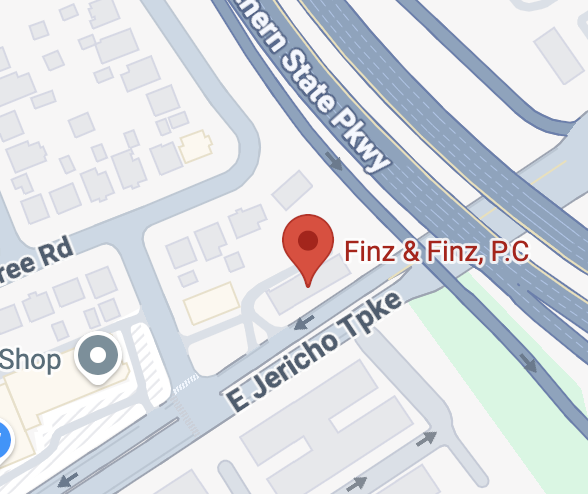
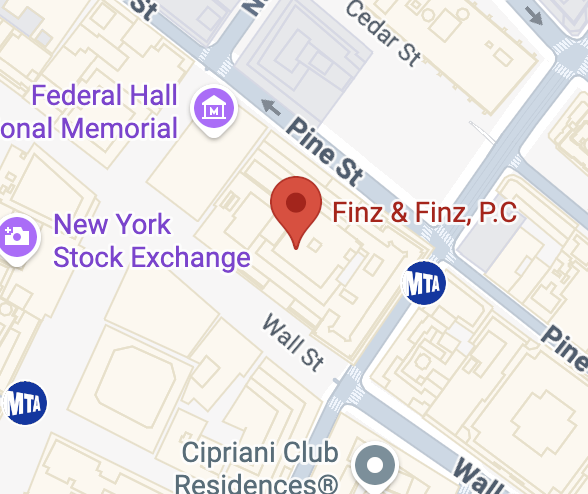
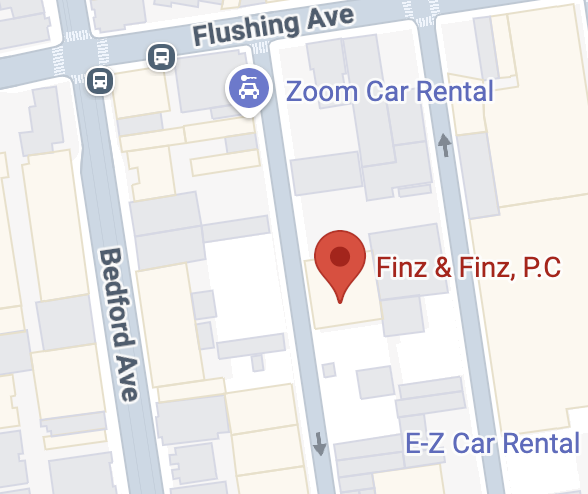
 Finz & Finz, P.C. has fought for injured New Yorkers since long before rideshare apps existed, and we apply that same trial-tested approach to Lyft cases today. Our offices sit at 40 Wall Street in Manhattan, Spencer Street in Brooklyn, and East Jericho Turnpike in Mineola, putting our Brooklyn team minutes from Kings County Supreme Court.
We have unwound the layered insurance disputes that come standard with a TLC vehicle crash, and we know how Lyft’s claims department tries to shift responsibility back onto the driver’s personal policy.
You bring us the facts of what happened. We bring the experience to find every dollar of coverage available and the willingness to take the case to trial if the offer on the table does not reflect what you actually lost.
Our Brooklyn team has watched insurers lean on the $100,000 TLC floor as though it were the final word on a case, when in reality, it is often just the opening position. Treating that number as a ceiling rather than a starting point is the single most common mistake we see unrepresented riders make.
There is no fee unless we win your case, and the initial consultation costs you nothing.




 More
More

 A Brooklyn Lyft accident lawyer at Finz & Finz, P.C. can help you recover compensation after a rideshare crash, and the first thing we do is find the insurance most passengers never knew was missing. Lyft tells its own drivers, in writing, that it does not provide coverage for trips that begin in the five boroughs of New York City.